 IndoorComfortKit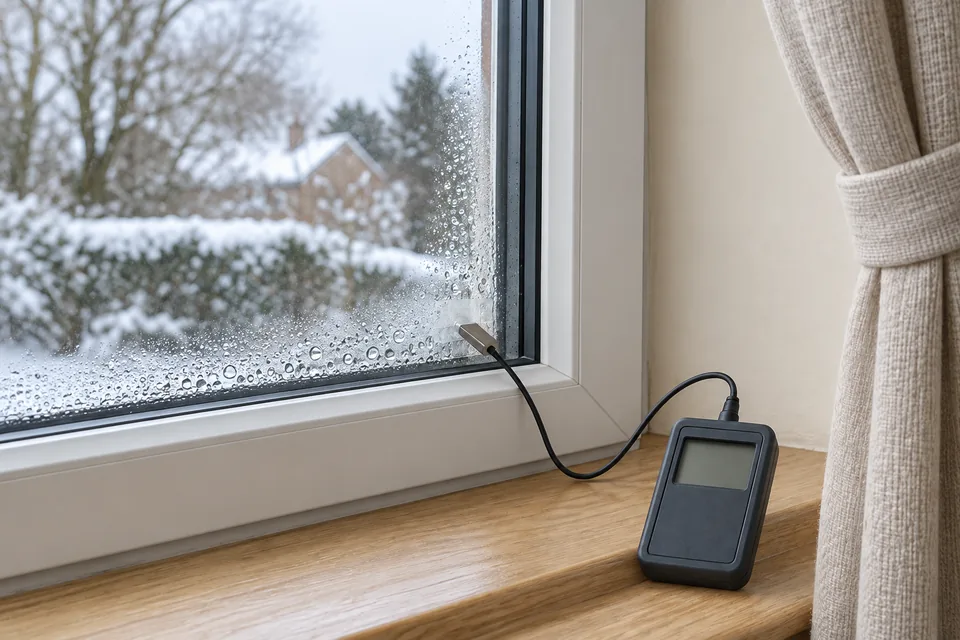
Where is the window wet?
Choose the closest observation. The location of the water changes what is useful to check next.
Water on the room-facing glass or frame
Dry accessible wet surfaces promptly. Note the affected side and area, then take a settled temperature and humidity reading in the occupied part of the room.
Measure the window surface separately only if you have suitable equipment. Room air and outdoor weather do not give you the glass temperature.
Compare room air with the windowNo surface measurement? The tool can explore an explicitly assumed window scenario. It cannot confirm why this window is wet.
Fog between the panes
If the fog is between sealed panes, changing room humidity may not address it. Note where it appears and arrange a window assessment if it persists. Do not dismantle glazing to check it.
When to arrange a closer inspectionWater follows rain or spreads onto the wall
Record the weather, timing and affected area. A room-air calculation cannot identify rain entry or hidden dampness. Address the water and seek a building or window assessment.
Read the inspection limitsMake the next reading useful
- Write what you read. Keep the actual local date and time, temperature, unit, RH, sensor and spot. Note window wetness and ordinary heating or ventilation use.
- Recheck in the same spot. Record any change you made and anything else that changed. Keep unknown conditions unknown.
- Compare without filling the gaps. Separate readings show what you observed at those times. They do not establish an all-day trend, recovery time or the cause of a change.
See how three home readings were documented. They are separate snapshots, not a winter experiment or a continuous log.
A basic meter works with paper notes or the room calculator. Use Keep a room record to download before refreshing; readings are not saved automatically.
The one-page PDF has space for four handwritten readings. Print it or use the text sheet for typed notes.
Why glass and frames collect room moisture
The relevant comparison is the room’s dew point against the indoor surface temperature. Air in the middle of a warm room can be far warmer than a window edge. A normal-looking room RH does not rule out condensation on that colder spot.
Start by locating the water, using the choices above. This guide concerns the first observation and response. For the calculation and measurement uncertainties, read dew point and window condensation. A room-air calculation cannot tell which side of the glazing is wet or identify a leak.
Record where and when the window becomes wet
Note the accessible room-facing glass, frame and nearby wall separately. Does the water appear after a shower, during cooking, after rain or when you wake up? A photo or short note can preserve the location, but do not delay drying accessible wet surfaces to complete a record.
Take temperature and RH in the occupied part of the room, away from the glass, direct sun and vents. Use the placement guide if the reading changes when you move the meter. Follow its settling instructions. Record any surface temperature separately with an appropriate instrument; an outdoor weather reading is not the glass temperature.
Why is the window wet at only 40% RH?
For this hypothetical example, 21°C and 40% RH give a calculated dew point of about 6.9°C. An assumed 5°C indoor surface is below that threshold; a 12°C surface is above it. These are not measured room or surface conditions. Open the calculated examples below for the comparison table.
The implication is narrow: the room percentage alone cannot decide what the window needs. If water is present while a humidifier is running, review added moisture and the window condition instead of treating 40% as a guaranteed setting. The winter humidity guide separates low room RH from wet glass.
Reduce moisture pulses and improve air contact with glass
Dry accessible wet surfaces and use the intended bathroom or kitchen exhaust during moisture-producing activities. Keep normal ventilation in use. Where practical, move curtains or stored items away from the wet area so you can inspect it and allow room air to reach it. Do not cover a repeated wet patch with paint or sealant as a substitute for finding its source.
Recheck the same spot during ordinary use. Record what changed and what else happened. A window drying after an action is useful to observe, but weather, room activity and surface temperature can also change; one comparison does not prove the action caused it.
What if just one bedroom window is wet?
Compare the bedroom with a nearby room at about the same time. Note closed doors, occupancy, coverings and which part of each window is affected. Similar room readings with different wetness shift attention toward local surfaces and airflow; different readings give a reason to investigate room moisture and ventilation too.
This is an observation workflow, not a controlled experiment or an instruction to seal vents. Window construction, exposure and sheltered edges vary. Do not infer a glazing rating or a repair from the fact that another room’s window is dry.
When window moisture needs a closer inspection
Fog between sealed panes, water following rain, spreading wall stains, soft finishes or recurring unexplained water require a closer window or building assessment. Reduce exposure to active water and address the affected materials. Do not dismantle glazing or investigate around electrical fixtures using this guide.
EPA supports moisture control and drying; DOE describes window thermal performance. Neither source diagnoses your window from a photo or RH value. This page does not identify mold, hidden moisture, glazing failure or building safety, and local construction and climate can differ from these U.S.-oriented references.
Related calculators
Explore the calculated examples
Why are windows wet at 40% humidity?
At 21 C and 40% RH, the calculated dew point is 6.9 C. A cold indoor glass surface can reach that temperature even while the room air is much warmer. Room humidity alone cannot supply the missing glass measurement.
| Example | Room air | RH | Calculated dew point |
|---|---|---|---|
| W1 | 21.0 °C69.8 °F | 30% | 2.7 °C36.9 °F |
| W2 | 21.0 °C69.8 °F | 40% | 6.9 °C44.4 °F |
| W3 | 21.0 °C69.8 °F | 50% | 10.2 °C50.4 °F |
| W4 | 18.0 °C64.4 °F | 40% | 4.2 °C39.6 °F |
| W5 | 24.0 °C75.2 °F | 40% | 9.6 °C49.3 °F |
W1–W3 hold room temperature at 21 C. The higher-humidity input reaches its condensation threshold on a warmer surface. W4 and W5 keep RH at 40% but change the temperature: they are different air conditions, not evidence that turning on heating adds moisture.
The table cannot predict the glass temperature, the amount of water, or how long a wet area will take to dry.
Examples checked: . Celsius dew points are rounded to 0.1 C, then converted to Fahrenheit. Display precision is not sensor accuracy. Calculation validation.
Same room air. Different glass.
Keep W2: 21 C, 40% RH, calculated dew point 6.9 C. The two surface temperatures below are assumptions, not measurements or estimates from outdoor weather.
| Assumed glass | Comparison | Meaning |
|---|---|---|
| 5 °C41 °F | Below 6.9 C | Surface condensation from this air is possible. |
| 12 °C53.6 °F | Above 6.9 C | This simplified comparison does not indicate condensation. |
A warmer reading is not a safety certificate. Edges and glass-adjacent air may differ from the sampled room, and both instruments have uncertainty. Room-facing moisture, water between panes and a wet surrounding wall require different observations.
What to record next
Use the same sensor and location during ordinary room use. Record temperature, RH, actual time, and nearby activity. Allow the meter to settle according to its instructions. Moving it changes both the location and the time; those readings are not a controlled comparison.
Describe whether water is on the accessible inside glass, outside, between panes, or on the frame and surrounding wall. A room-air calculator cannot distinguish a leak from a glazing issue. Do not create moisture or delay drying to complete a record.
Two readings can describe a difference, but cannot establish its cause, a recovery curve or an equipment fault. Leave missing values unknown. The examples in this guide are hypothetical, not records from our home.
Room-level watch signal, not a mold test, health diagnosis, air-quality test, building inspection, HVAC design, or safety certification.
Compare my room readings
Sources and method notes
- EPA mold and moisture guide
Source checked:
Supports: Responding to condensation, reducing moisture sources and drying wet surfaces promptly.
Does not support: The site's observation workflow, a dew-point calculation, rain-entry or glazing diagnosis.
- Purchasing Energy-Efficient Residential Windows, Doors, and Skylights | U.S. Department of Energy
Source checked:
Supports: Window thermal properties, air leakage, and condensation-resistance ratings as factors in interior moisture or frost formation.
Does not support: The cause of moisture at a specific window, the site's observation workflow, flashing or seal diagnosis, or a repair recommendation.